
The Productivity Bar Just Reset. Talent Access Is How You Keep Up.
a16z data shows top companies generating $700K ARR per employee - up 2x since 2018. The old benchmark of $200K is now the median. Here is what that means for how companies build teams.
 Tony Buffum
Get this in your inbox every week. Join 26,000+ subscribers.
a16z recently shared a stat that should stop every executive mid-slide.
Top 10% companies are now generating roughly $700K in ARR per employee, up more than 2x since 2018. The old benchmark of $200K is now closer to the median.
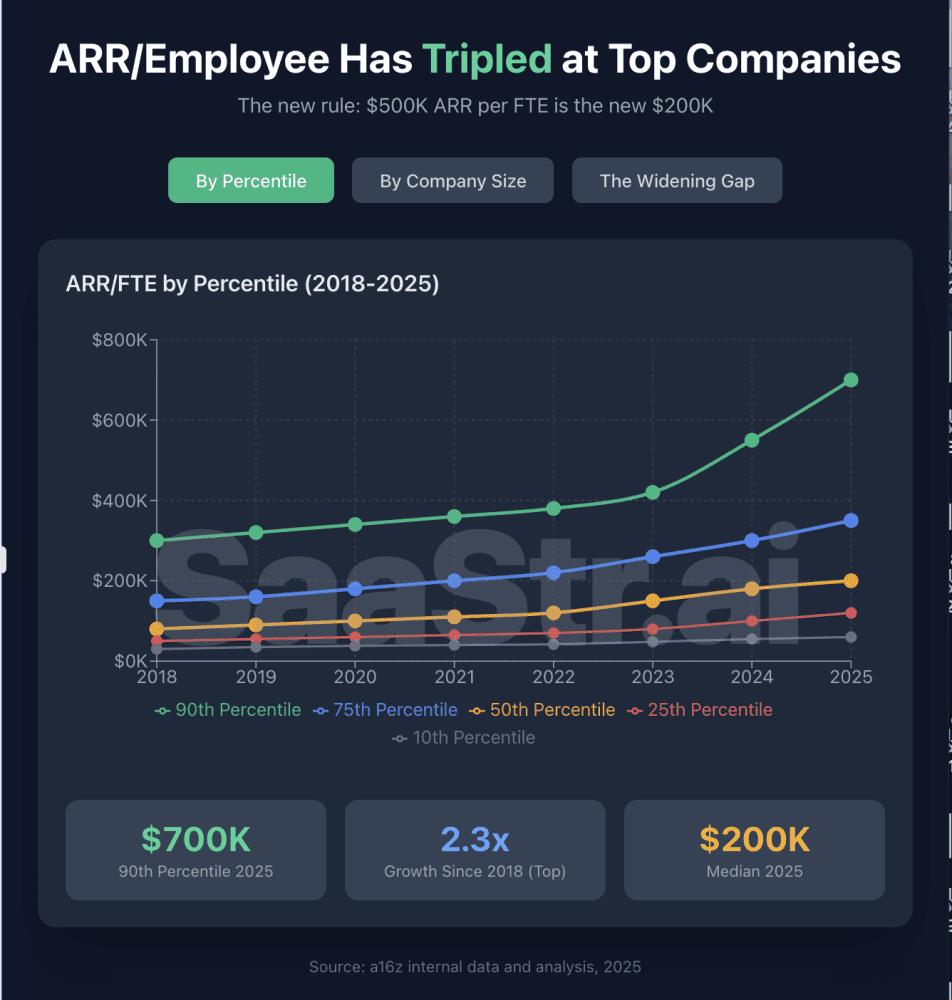
This is not just a startup flex. It is a signal.
The productivity bar is not creeping up. It just reset.
And AI is the forcing function behind it.
This is not about fewer jobs. It is about different work.
There is a lot of noise right now about AI-driven job loss.
A recent survey of CFOs suggests over 500,000 roles could be impacted by AI in 2026, a sharp increase year over year.2
That sounds dramatic. But the more important insight is underneath it.
Roughly 40%+ of those changes are restructuring, not pure reduction.3
Companies are not simply cutting. They are reallocating.
We are seeing it everywhere:
- Roles tied to repeatable execution are shrinking
- Roles tied to judgment, problem solving, and innovation are expanding
- Entire workflows are being redesigned, not just optimized
Atlassian is a good example. They reduced roles in areas like QA and support while simultaneously investing heavily in AI engineering talent.4
This is not a hiring slowdown.
It is a work redesign cycle at scale.
The real problem: our talent models have not caught up
Here is where most enterprises get stuck.
They see the productivity gains. They feel the pressure to do more with less. But they try to solve it inside a model that was built for a different era.
Traditional employment is still anchored in:
- Fixed roles
- Fixed costs
- Fixed scope
- Linear incentives
That model struggles in a world where productivity is no longer linear.
If one person becomes 3x more productive with AI:
- The company captures most of the upside
- The individual sees little change in reward
- The role itself often becomes unstable
That misalignment is not theoretical. It is already showing up in behavior.
Top talent is increasingly choosing flexible, independent, and portfolio-based work where they can capture the value they create.
And enterprises are quietly following, even if they are not calling it strategy yet.
Talent Access is not a trend. It is the operating model shift.
This is where I think the conversation needs to evolve.
This is not about "gig work" or "freelancers."
This is about Talent Access as a core workforce strategy.
Access means:
- Getting the right skill, not just filling the role
- Paying for outcomes, not time
- Scaling capability up and down based on demand
- Continuously reconfiguring work as technology evolves
And importantly, it aligns incentives in a way traditional models often do not.
Leaders get:
- Speed
- Precision
- Measurable impact
Talent gets:
- Greater control
- Direct connection to value creation
- More upside tied to outcomes
That alignment is powerful. And it is why flexible models are not just surviving this shift. They are accelerating.
Startups are already operating this way. Enterprises are next.
We are seeing a clear pattern: smaller, more agile companies are building lean cores with expansive external networks. It is not uncommon now to see:
- 20 to 30 full-time employees
- Hundreds of specialized contributors engaged on demand
This is not a workaround. It is a design choice. Because it allows them to:
- Identify value faster
- Swap in expertise quickly
- Adapt as priorities change
And increasingly, they are outperforming much larger organizations because of it.
Enterprises have an advantage. But only if they use it.
Here is the optimistic part that often gets missed.
Large organizations are not at a disadvantage. They just have to make a deliberate shift.
They already have:
- Brand
- Capital
- Data
- Distribution
What they need is a more dynamic way to deploy talent against that advantage.
That is where Talent Access becomes a multiplier.
Platforms, marketplaces, and ecosystem partners are not just procurement tools. They are the fastest path to inject new capability, test new work models, and redesign how work gets done.
Even leaders like Elon Musk are framing it this way. The goal is not simply fewer employees. It is dramatically higher output per person, supported by a broader ecosystem of contributors.5
The bottom line
The question is no longer: "How do we hire more efficiently?"
It is: "How do we continuously access the right talent to match the work, at the moment the work exists?"
The companies that answer that question well will not just keep up with the new productivity bar. They will redefine it.
And the ones that do not? They will keep optimizing a model that is already being outpaced.
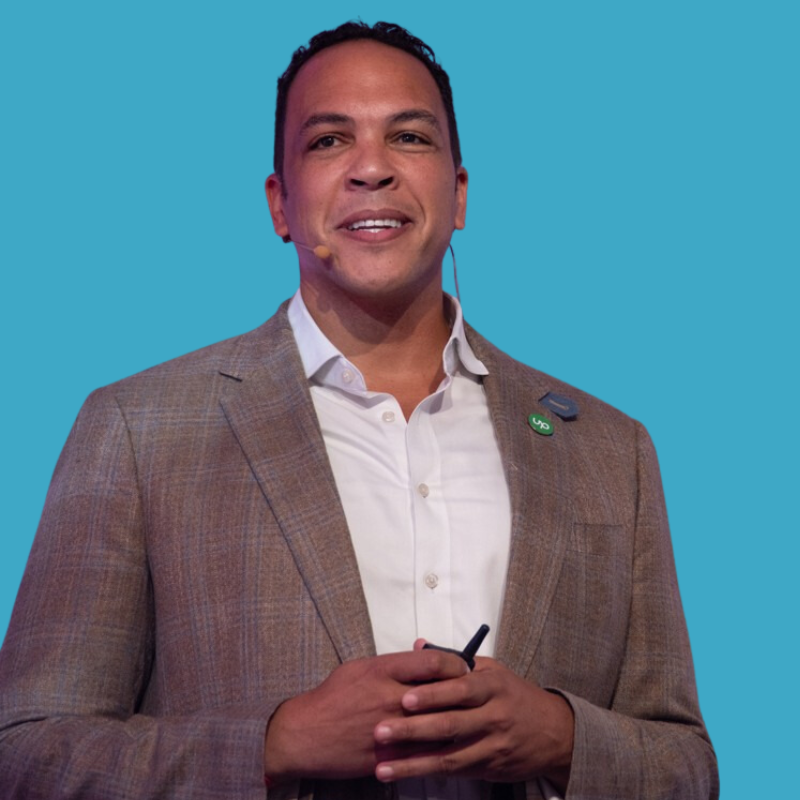
- Tony Buffum, Co-Founder & CSO
Human Cloud - Meet the way the world works. Learn more →
PS: Use HC 3.2 to create a shortlist of potential talent partners in minutes. Tell us what you need and we surface the right solutions - no more vendor calls or RFP cycles.
Come See Us
Running Remote - April 27-29, Austin TX
We will be at Running Remote at FairMarket in downtown Austin. If you are attending, come find us - we would love to connect on how your organization is navigating the shift to flexible talent.
Learn More →Reply to get involved.
Boston Tech Week - AI Session, May 26-31
We are leading an AI session at Boston Tech Week. More details coming soon on the topic and timing. If you are in the Boston area, mark your calendar.
Learn More →Reply to get involved.
Platform Pulse - Week of April 6, 2026
165% Month-over-Month Growth
March was our biggest month ever. 7,514 unique visitors - up 165% from February's 2,835. January was 2,719. The platform has nearly tripled in three months.
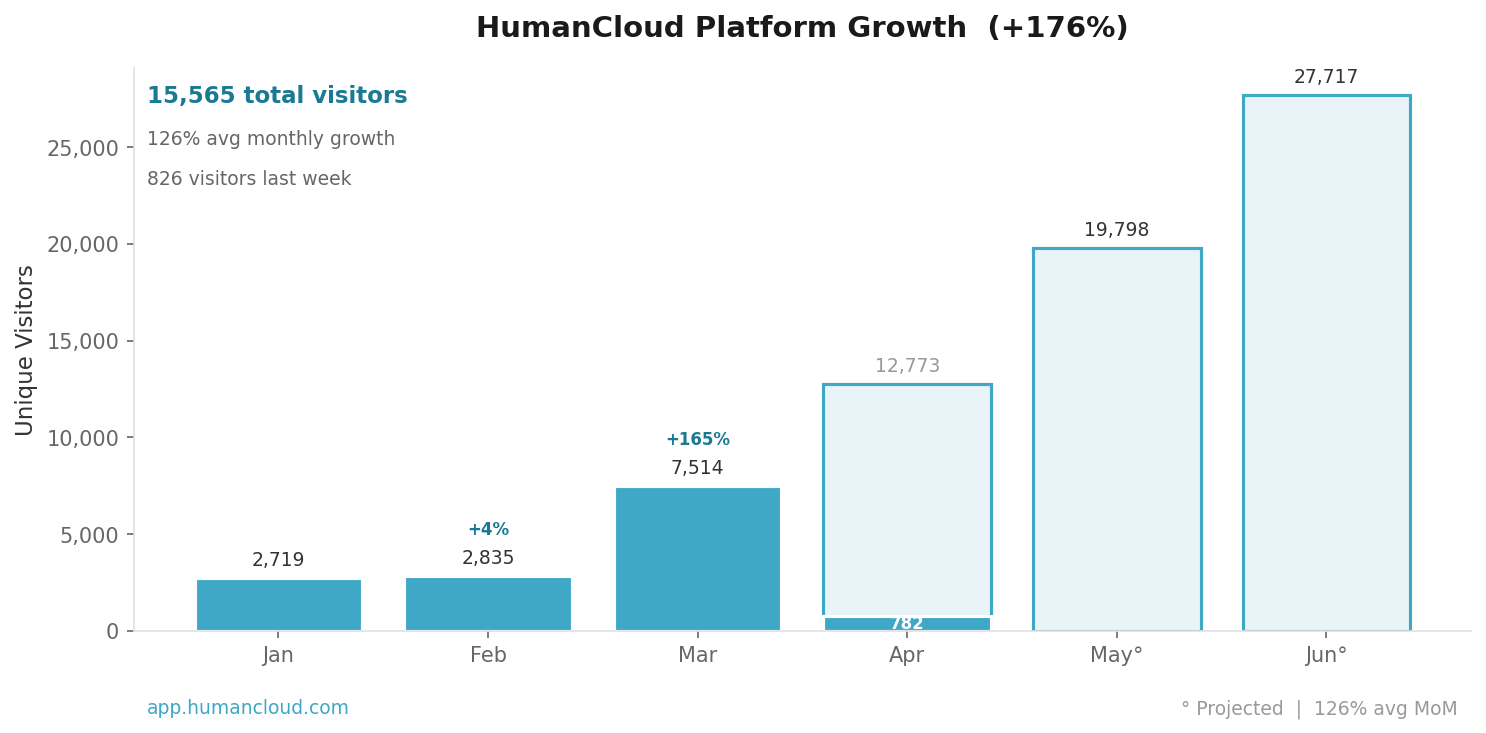
Beyond the growth, here's what the data is showing:
- New categories emerging: Customer Experience (70 views), Events (55), Sales (53), and Manufacturing (52) are all trending this quarter. Buyers are expanding beyond traditional staffing into specialized, outcome-driven functions.
- Search signals shifting: LATAM (52 views), Asia (51), and Legal (50) are emerging as significant search categories. Companies are looking for talent in specific regions with specific compliance requirements.
Where Demand Is Flowing
Customer Experience (trending)
On-demand CX delivered through expert gig workers who are actual product users and brand advocates.
Istanbul, Turkey
Freelance-based CX agents that drive revenue. 5x revenue growth and 30% cost reduction for clients like Cimri and Hepsiburada.
Diemen, Netherlands
Global digital talent solutions for technology and customer experience professionals.
Sales (trending)
LatAm-based talent helping companies hire top sales and ops professionals at competitive rates.
Specialized recruiting for sales and marketing from Latin American talent pools.
B2B lead generation and LinkedIn outreach that drives qualified sales conversations at scale.
Manufacturing (trending)
On-demand labor platform connecting businesses with vetted temporary workers.
San Francisco, US
AI-powered staffing marketplace for vetted hourly frontline workers.
On-demand labor marketplace for manufacturing, warehousing, and logistics.
Change Management (trending)
Fractional and interim executive search for transformation initiatives.
Los Angeles, US
On-demand access to top independent consultants, executives, and project teams.
Technology (trending)
Sao Paulo, Brazil
AI-powered ecosystem connecting companies with top LATAM tech talent.
Unrivaled access to global engineering talent with seamless hiring and retention.
Indianapolis, US
Global crowdsourcing platform for developers and designers.
Creative (trending)
Copenhagen, Denmark
Unified freelance management platform for global workforce.
Raleigh, US
Hybrid creative agency and freelance staffing for brand strategy, video, and creative execution.
Industry Intel
1. Atlanta Fed: AI job cuts to hit 502,000 in 2026 - but the real story is role recomposition
A survey of 750 CFOs found AI-related cuts will reach 502,000 roles - a 9x increase from 2025 - yet that is less than 0.4% of the total workforce.2 Executives perceive large productivity gains that have not yet shown up in revenue data. What is showing up: routine clerical roles declining, skilled technical roles rising. Companies are reshuffling what work gets done and by whom.
2. Atlassian cuts 1,600 while hiring 800 AI roles in the same quarter
Over 900 cuts in R&D, content, QA, and support.4 800 new roles in AI engineering, ML ops, and AI safety.3 Net reduction: 800. But workforce composition is fundamentally different. 42% of 2026 layoffs are restructuring, 39% are AI budget realignment.
3. SIA: 2026 is "the turning point" for contingent workforce
US staffing industry forecast to grow 3% to $195 billion.6 AMS estimates contingent workers will represent 50% of the US workforce by 2035, up from 38%. Enterprises now treat contingent talent as a labor supply chain. Skills-based hiring is replacing job-title matching.
4. 75% of TA leaders plan to replace their recruiting platform within two years
Despite 82% satisfaction, three-quarters expect to swap platforms - driven by ambition for AI-powered matching.7 HR tech investment hit $4.93B through Q3 2025 (up 20% YoY).8 65% of recruiters now use AI daily.
5. BCG: AI transformation is fundamentally a workforce transformation
72% of CEOs now own AI strategy (double from last year).9 BCG argues 70% of AI value comes from workforce changes, not the technology.10 50-55% of US jobs will be reshaped in the next 2-3 years. For each role: build (train FTE), buy (hire FTE), or borrow (engage contingent).
Sources
- SaaStr: $500K ARR Per Employee is the New $200K - a16z data, 2025
- Fortune: CFO Survey on AI Job Cuts - Atlanta Fed / Duke, March 2026
- CNBC: Atlassian Cuts 10% of Workforce - March 2026
- TechCrunch: Atlassian Cuts Staff for AI - March 2026
- Moonshots #239: Elon Musk - Abundance360, March 2026
- SIA: 2026 Turning Point for Contingent Programs
- HR Executive: Recruiting Platforms Get Budget Priority
- HR Executive: Billions Into HR Tech
- BCG AI Radar 2026
- BCG: AI Transformation Is Workforce Transformation
What is Human Cloud?
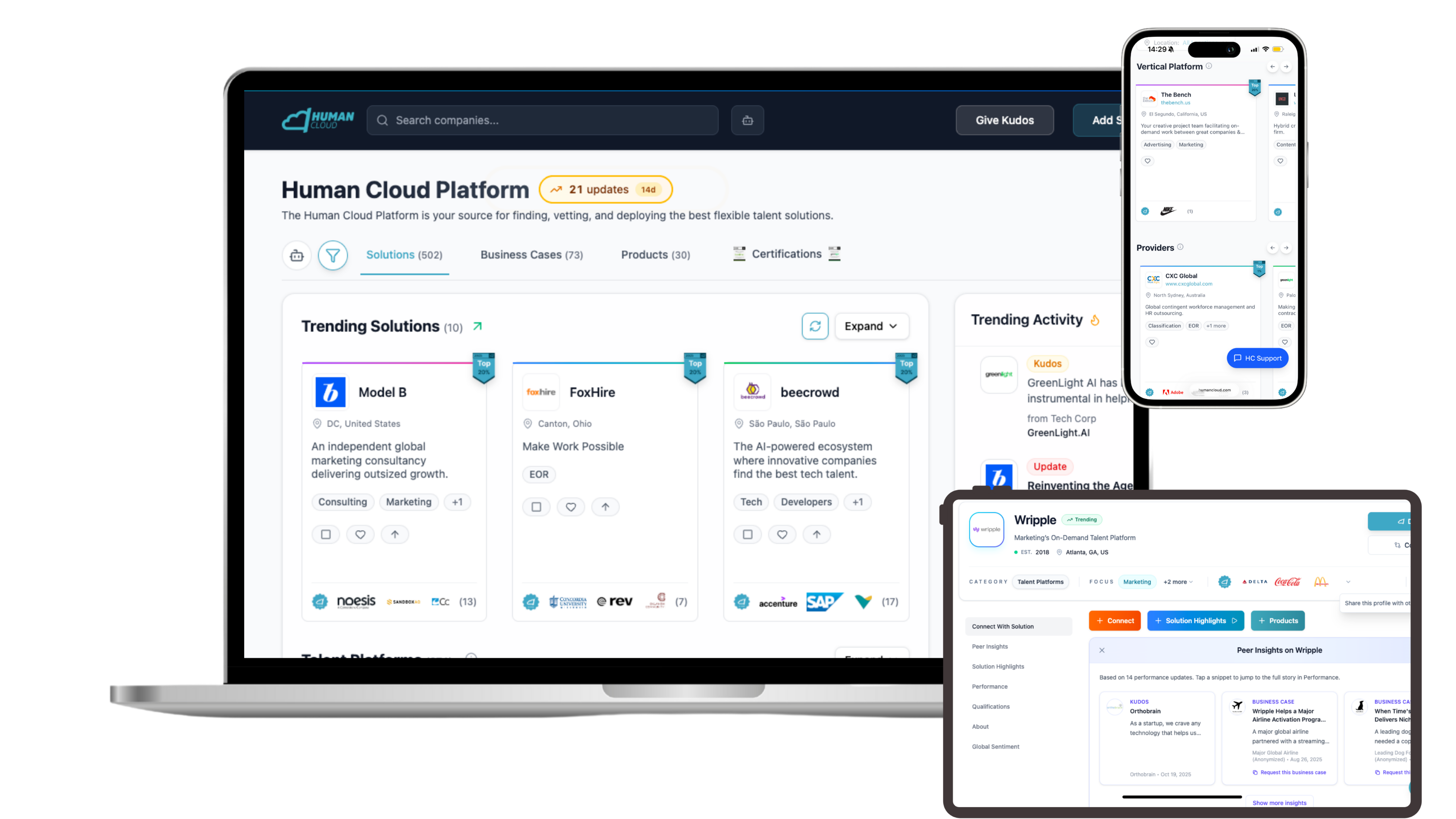
Human Cloud helps companies find and deploy the right flexible talent solutions in minutes instead of months.
We automate discovery, compliance, and orchestration across 1,000+ workforce platforms-so business teams move fast, procurement teams stay in control, and rogue contractor spend turns into a strategic advantage.
By using Human Cloud, Companies can:
- ✓ Shortlist 10+ ideal solutions in minutes (not weeks)
- ✓ Deploy 3+ marketplaces in under a day (not 6-12 months)
- ✓ Turn 60% rogue contractor spend into a governed, strategic workforce
Get insights like this every week
Join 26,000+ leaders staying ahead of the flexible talent market.